The Talent "Management-Agency" Trap: Mainly, There's No Such Thing

Updated: Aug 17

by TWR. Editorial Team | Monday, August 17, 2026 for The Weekend Read.
Why the ambiguity hurts talent, creates avoidable risk for brands, and can put companies and their owners on the hook for commissions and unpaid money.
California law does not recognize a magic hybrid category. Recent creator-economy rulings show how pitching brands, negotiating posts, and selling custom content can turn an unlicensed manager into an unlawful talent agency.
It went down in the DMs
The account managers were not just posting photos. They were selling access to a performer.
According to a 2024 decision from the California Labor Commissioner, Unruly Agency had a 25 percent management agreement with model and content creator Sarah Stage. Its employees had access to her paywalled account. They messaged subscribers, upsold existing content, fielded requests for personalized videos, and negotiated prices. Subscribers believed they were speaking with Stage. Often, they were speaking with an account manager.
One subscriber requested a custom video. Another wanted a fitness video focused on abs. In one exchange described in the ruling, an account manager proposed a $50 price for a personalized response. The communications numbered in the hundreds each day. Stage retained the final decision on whether to make custom content, but the company was doing the work that brought the paid engagements to her.
Unruly described itself as a boutique marketing company for the management of influencers. It was not licensed as a California talent agency. That branding did not decide the case. The Labor Commissioner found that the daily solicitation and negotiation crossed the line from career management into talent procurement. The contract was declared illegal, void, and unenforceable.
California does not regulate the title in a bio. It regulates the conduct in the email, the DM, the pitch deck, and the negotiation.
The decision should be a flare over the creator economy. A large class of companies now sells an all-in-one promise: strategy, posting, audience growth, inbox management, brand outreach, rate negotiation, contracting, and payment collection. The preferred label is often management agency, a phrase that sounds comprehensive and reassuring. Under California law, it is not a recognized third category. It may be a description of a business. It is not a license.
OnlyFans is not the exception or the loophole. It is simply the newest fact pattern in a law that follows the work across platforms. The same legal question can arise when a representative pitches an Instagram sponsorship, negotiates a YouTube integration, prices a TikTok campaign, arranges a podcast appearance, secures a modeling engagement, or books a live performance.
Three words doing too much work
A manager and a talent agency can both support a creator. Their legal functions are not interchangeable.
A manager can advise, plan, coordinate, develop a brand, shape a content strategy, help assemble a team, and make a creator more marketable. A licensed talent agency may also counsel a client, but its defining regulated function is procuring, offering, promising, or attempting to procure employment or engagements for an artist. California uses a functional test. If a person or company performs procurement, the law treats that conduct as talent-agency activity, whatever the contract, website, LinkedIn page, or job title says.
By the time the creator understands the distinction, years of messages and commissions may already exist, while the strongest affirmative remedy is shrinking month by month.
That does not make management unlawful. It means the words cannot be blended to erase the boundary. A business may operate a management company and a separately licensed talent agency. A manager may coordinate with a licensed agency. But the entity doing the regulated work must be licensed, or it must fit a statutory exception. Calling a manager an agency, or an agency a management company, changes nothing.
The "generic word agency" is especially slippery. It can refer to an advertising agency working for a brand, an influencer-marketing shop sourcing campaign participants, or a licensed talent agency representing creators. Those roles are not automatically the same. The risk becomes acute when a company claims to represent the creator, reaches out for paid work, negotiates the creator’s compensation or deliverables, and takes a percentage of the creator’s earnings.
California’s rule, stripped of jargon
The Talent Agencies Act defines a talent agency by the act of procurement. It covers attempts as well as completed jobs. Its protected class includes models and many other people providing professional entertainment services. A social platform does not place that work outside the statute.
At the same time, being an influencer is not, by itself, an automatic ticket into the Act. The Labor Commissioner has said artist status is evaluated case by case, based on the services actually performed.
Licensure is not a ceremonial filing. California requires a license before a person carries on the occupation of a talent agency. A licensed agency must post the license and use its number in talent-solicitation advertising. It must place a $50,000 surety bond with the Labor Commissioner. The agency’s artist contract form must be submitted for approval and must state prominently that the agency is licensed.
When the agency receives money for an artist, it generally must deposit the funds into a trust account, keep records, and disburse the artist’s share within 30 days, subject to specified exceptions.
This is why “bonded and insured” is not a complete answer. The statute requires a surety bond. General liability, errors-and-omissions coverage, or some other insurance policy does not substitute for a California talent-agency license, an approved contract, or the statutory trust-account rules.
Yes, a brand deal can be the job
The cleanest modern example is Bostanian v. Rao, another 2024 Labor Commissioner ruling. Abby Rao was an Instagram model and influencer. Her unlicensed manager negotiated with Fashion Nova over sponsored posts and swipe-ups, told the company he negotiated her deals, sought higher per-post compensation, made a $9,000 counteroffer, accepted an $8,000 offer, requested the contract, and directed payment to a management-company PayPal address.
He later told Rao he had obtained a $6,000-per-month deal for six posts and three swipe-ups.
He received an exorbitant 25 percent commission on at least one Fashion Nova deal.
The Labor Commissioner did not treat those posts as something less than work because they happened on Instagram. Rao was modeling clothing and promoting a product for pay. The platform was merely the distribution channel. Negotiating the price, the number of posts, the swipe-ups, and the payment was procurement of an engagement for an artist.
The unsuccessful pitches counted too. The manager proposed $5,000 per post to Benjamin Watches and discussed asking Rockstar Energy for $1,500 per post with a three-post minimum. Neither effort had to close. The statute expressly reaches offers, promises, and attempts to procure.
The same decision also shows where careful reporting matters. Communications with Revolve, Hello Molly, and Suspicious Antwerp were not proven to be unlawful procurement.
On that record, they looked more like efforts to gain exposure, develop Rao’s profile, and make her more attractive to buyers.
The line is not every introduction versus no introduction. The line is what the representative was actually trying to obtain, how actively the representative participated, and whether compensation and terms for an artist’s services were on the table.
The inbound-only myth
A common compliance story says a manager is safe if the brand contacts the creator first. That is too broad.
Simply forwarding an unsolicited inquiry is different from becoming the dealmaker. But once the representative actively participates in communications aimed at obtaining the engagement, quotes a rate, negotiates deliverables, counters compensation, accepts terms, or directs the payment, the fact that the brand sent the first email is not a universal shield.
In Stage, the Labor Commissioner cited a procurement standard that can apply regardless of who initiated the communication.
The contract disclaimer is not a shield either. A clause saying the manager will not procure employment can help define a lawful role, but it cannot erase a pitch log full of rate cards, counters, acceptances, and payment instructions.
Conduct beats boilerplate.
Why creators lose even before anyone sues
The obvious creator risk is paying a percentage to someone who may have no lawful right to collect it. The less visible risk is the loss of the protections the licensing system was built to provide.
No verified license. A creator may be entrusting a major revenue stream to a company that has not passed through the state’s licensing process. Ask for the exact legal entity, any DBA, and the current license number, then verify it in the state’s database.
No approved agency contract. A polished PDF from a management firm is not the same as a talent-agency form reviewed under section 1700.23. The difference matters when the agreement is exclusive, long-term, or takes a percentage of broad gross revenue.
No statutory money-handling framework. If campaign money is routed through the representative, creators need to know whose account holds it, when it must be released, what can be deducted, and what records exist. Licensed agencies have express trust-account and disbursement duties.
A structural conflict. A manager who is paid only when revenue arrives has a commercial incentive to cross from advice into procurement. The creator may believe the firm is licensed because it calls itself an agency, while the contract says it is only a manager.
A short clock for affirmative recovery. The Act generally bars proceedings based on violations more than one year old. Creators who wait may preserve a defense to a commission claim while losing a timely demand for repayment.
The result is perverse. The creator may need the representative most when the creator has the least bargaining power and the least money for counsel. By the time the creator understands the distinction, years of messages and commissions may already exist, while the strongest affirmative remedy is shrinking month by month.
Why brands should care
Brands often treat representation status as the creator’s private problem. That is shortsighted.
A brand is not automatically liable under the Talent Agencies Act merely because it bought a campaign, and invalidating a manager’s representation agreement does not automatically erase the brand’s separate contract with the creator. Still, an unverified representative can inject avoidable risk into every stage of the campaign.
Authority risk. Who can bind the creator, accept revisions, approve usage, or change a fee? If the representative’s own agreement becomes disputed, the brand may discover that the person running the negotiation had less authority than everyone assumed.
Payment risk. If money is routed through the representative, the brand needs verified instructions and a clear account of who is entitled to receive the funds. An unlicensed intermediary does not provide the statutory trust-account protection applicable to a licensed agency.
Discovery and delay. Campaign emails, DMs, rate negotiations, statements of work, and payment records can become evidence in a Labor Commissioner proceeding or related litigation. The brand may be a witness and document custodian even when it is not the target.
Reputational risk. A campaign built around authenticity can sour quickly if the public record shows a creator’s supposed advocate concealed its role, controlled the creator’s account, or withheld money.
Brand teams should separate the roles in writing. A brand-side marketing agency may source and administer a campaign for the buyer. A creator-side licensed talent agency may procure and negotiate for the artist. A manager may advise the creator.
One company can sometimes perform more than one function, but a single email signature should not be allowed to blur who represents whom, who is licensed, and who gets paid.
The people inside the company are not invisible
The word company can create a false sense that individual decision-makers are insulated. Personal exposure is not automatic, and a junior account manager does not become liable simply because a job title contains the word rep. But California decisions look at personal direction, authorization, control, and participation.
In a 2024 consolidated case involving models and a management company that operated during periods without a talent-agency license, the Labor Commissioner found one former owner was not personally liable because he had sold the company and no longer controlled its workers or operations.
The new owner and chief financial officer was found individually liable. He supervised employees who procured work while the company was unlicensed, prepared disputed financial statements, and participated in the failure to pay models. The order included unpaid compensation, commission disgorgement, interest, and attorney fees.
That is the useful distinction for the people working inside creator-management firms. An employee is not automatically the company’s balance sheet. But owners and officers who authorize an unlicensed procurement model, control the money, or personally participate in wrongful conduct should not assume the LLC suffix ends the analysis.
Other staff may still become central witnesses because the evidence lives in their inboxes, Slack threads, DMs, rate cards, and payment instructions.
The remedy is not “backpay,” and it is not unlimited
Backpay is the wrong shorthand for most of this exposure. The representative is usually not the creator’s employer.
The central remedies are different: declaring all or part of a representation agreement illegal or unenforceable, defeating a claim for commissions, ordering disgorgement or restitution of commissions, and accounting for or returning money held for the artist. Separate wage or payment claims can exist on their own facts.
The exposure can be severe. Stage’s agreement was declared illegal, void, and unenforceable, and Unruly was barred from trying to enforce it. In Bostanian, the agreement was void from the beginning because procurement language and conduct permeated the deal.
But the viral version of the rule, one illegal pitch means every dollar ever earned must be returned, is wrong. The California Supreme Court’s Marathon decision requires a fact-specific severability analysis.
If the illegal procurement is collateral to a contract whose main purposes are lawful, a decision-maker may sever the tainted part and preserve compensation for legitimate management services. If procurement is central to the bargain, the whole agreement may fall.
Timing creates another limit. Section 1700.44(c) generally imposes a one-year period for affirmative claims based on violations. Rao won the argument that her agreement was void, but her request to recover money was denied as untimely.
By contrast, Styne v. Stevens holds that an artist sued for commissions may be able to raise illegality defensively even when a claim for affirmative repayment would be late. The dispute still must go first to the Labor Commissioner when the Act is genuinely implicated.
The real exposure is not automatic lifetime clawback. It is a fact-specific mix of contract invalidation, lost commissions, disgorgement, accounting, interest, fees, and personal liability.
This distinction matters for everyone. Creators should not sleep on the one-year clock. Firms should not assume severability will rescue a contract built around pitching and closing deals. Brands should not assume the creator-representative dispute can never touch campaign records or payments. Writers should resist turning a potent statute into a slogan that the cases do not support.
What a lawful structure can look like
California does provide a practical path.
A licensed talent agency can be the procuring entity. The manager can focus on strategy, development, positioning, and career coordination. When a negotiation benefits from the manager’s participation, section 1700.44(d) says an unlicensed person may act in conjunction with, and at the request of, a licensed talent agency in negotiating an employment contract.
The licensed agency needs to be real, identified, and involved. It should not appear after the fact as a decorative name on an invoice.
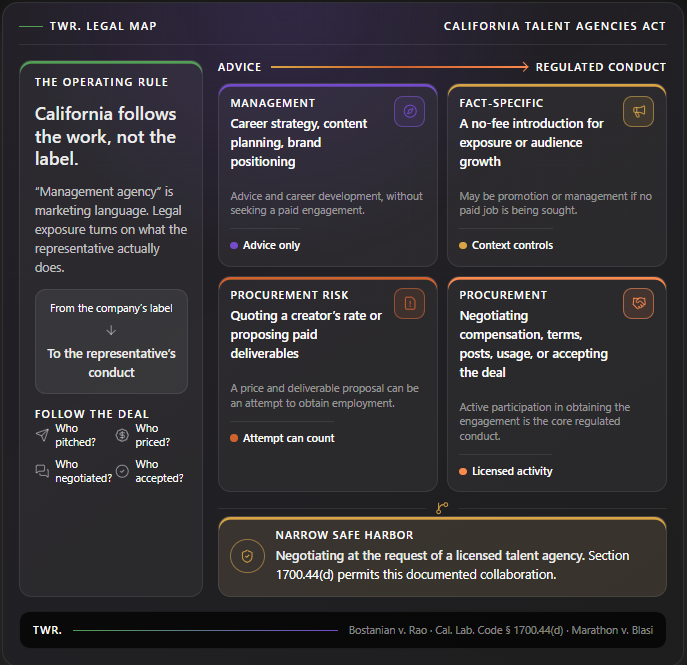
The operational map should be visible in the documents and communications:
Which legal entity represents the creator?
What is its license number?
Who made the pitch?
Who negotiated the economics?
Whose contract form governs?
Who has authority to accept?
Where is the money deposited?
Which commission applies?
Who issues the accounting?
A company that truly operates both management and agency businesses should be able to explain the separation in one minute.
If the answer is a cloud of branding language about full-service representation, proprietary relationships, and end-to-end monetization, the creator and the brand should pause until the legal entity and licensed role are clear.
The creator-beware checklist
Get the exact entity. Ask for the full legal name on the contract, every relevant DBA, the business address, and the name of the person who will perform the work.
Ask the decisive question. Will you solicit, pitch, quote, negotiate, accept, or attempt to obtain paid engagements for me?
Verify the license yourself. Request the California talent-agency license number and confirm the exact entity in the Labor Commissioner’s database. A search under a marketing name alone is not conclusive.
Find the licensed agency on the thread. If the manager says it works with an agency, ask which one, when that agency was engaged, and whether the manager is acting at that agency’s request.
Follow the money. Know who invoices the brand, which account receives the money, when you are paid, what deductions are permitted, and what statement you receive.
Preserve the evidence. Keep pitches, rate cards, DMs, email chains, contracts, invoices, payment records, and commission statements. Labels are weak evidence. Conduct is strong evidence.
Do not wait. Because affirmative relief may be limited by a one-year period, seek advice from California entertainment counsel promptly if unlicensed procurement may have occurred.
The brand-side checklist
Confirm whom the rep represents. Do not let a brand-side campaign administrator quietly become the creator’s commission-based representative, or vice versa, without conflicts and authority being addressed.
Request written authority. The campaign file should show who may negotiate, approve, sign, and receive payment for the creator.
Verify licensing when the rep procures. If the representative is pitching or negotiating for a California artist, obtain and verify the exact licensed entity rather than relying on the word agency.
Contract with the right party. Make the creator or the creator’s legitimate loan-out entity a clear contracting party unless counsel has approved a different structure.
Keep a clean audit trail. Document rate proposals, counters, deliverables, usage, approvals, payment instructions, and any role played by a manager or licensed agency.
TWR. provides independent analysis for informational purposes only. Nothing in this article constitutes investment advice or a recommendation to buy or sell any security.
The question every “management agency” must answer
What, exactly, do you do when a brand deal appears?
If the answer is that the company identifies buyers, pitches the creator, proposes rates and deliverables, negotiates compensation and usage, accepts the engagement, and collects a percentage, California may not see an innovative hybrid. It may see talent-agency conduct.
The phrase management agency can be honest shorthand for a company with managers and a lawful licensed-agency relationship. It can also be camouflage for a business model built on procurement without the license, bond, approved contract, trust account, and oversight that procurement triggers.
The title does not tell you which one you are dealing with.
Creators should ask for the license. Brands should ask who is authorized. Employees should ask what their pitch-and-close workflow legally makes them. Owners should ask whether the company could defend its role using the emails it sends every day.
California’s rule is not complicated at the center: the law follows the work.
TWR. Last Word: The creator economy can invent new platforms, new titles, and new middlemen--new meaning of words even ("chopped?"). The law still follows the work: who pitched the artist, negotiated the deal, and took the commission.
Insightful perspectives and deep dives into the technologies, ideas, and strategies shaping our world. This piece reflects the collective expertise and editorial voice of The Weekend Read — 🗣️Read or Get Rewritten | www.TheWeekendRead.com
Nomenclature
Management Agency: An industry marketing phrase commonly used by companies that combine career management with deal-related services. California does not recognize a management agency as a separate legal category, so each service is judged by what the company actually does.
Talent Agency: A person or company engaged in procuring, offering, promising, or attempting to procure employment or engagements for artists. Performing this function in California generally requires a talent-agency license.
Talent Manager: A representative who advises an artist on career strategy, development, branding, positioning, scheduling, and long-term planning. The title manager does not authorize the representative to procure employment without a license or statutory exception.
Artist: A person providing professional services in an entertainment field, including actors, musicians, writers, directors, models, performers, and certain other creators. Whether a social-media influencer qualifies as an artist depends on the services actually being performed.
Procurement: Conduct directed at obtaining employment or a paid engagement for an artist. Soliciting buyers, pitching talent, proposing rates, negotiating compensation, discussing deliverables, and accepting terms can all become evidence of procurement.
Attempted Procurement: An effort to obtain work for an artist that does not result in a completed deal. California law can regulate the attempt itself, meaning an unsuccessful brand pitch may still count.
Employment or Engagement: A paid arrangement under which an artist provides professional services. The term can include performances, appearances, modeling assignments, sponsored content, custom videos, social posts, and other compensated creator work.
Brand Deal: A commercial agreement in which a creator is paid to promote, model, demonstrate, endorse, appear with, or create content involving a product or company. A deal does not fall outside talent-agency law simply because the work appears on a social platform.
Inbound Inquiry: An unsolicited approach from a brand, advertiser, producer, or buyer interested in working with a creator. Receiving or forwarding an inquiry may be administrative, but quoting rates, countering compensation, negotiating terms, or closing the deal can create procurement risk.
Career Development: Work intended to improve an artist’s skills, positioning, audience, materials, or long-term marketability without obtaining a particular paid engagement. Career development is generally associated with lawful management activity.
California Nexus: The connection between California and the artist, representative, procurement activity, contract, buyer, production, or resulting work. Whether California law applies to an out-of-state or foreign company depends on the complete facts, not simply the location of its headquarters.
Talent-Agency License: The authorization issued by the California Labor Commissioner permitting a specific person or legal entity to operate as a talent agency. A marketing name, website description, or claim of being bonded does not substitute for a valid license.
Legal Entity: The individual, corporation, limited liability company, partnership, or other organization that enters the representation agreement and performs the services. Licensing should be verified against the exact contracting entity.
DBA: An abbreviation for “doing business as,” meaning a trade name used by a legal entity. Searching only the public-facing brand name may not conclusively establish whether the underlying company holds a talent-agency license.
Surety Bond: A financial guarantee required of licensed California talent agencies. The current statutory amount is $50,000, but possession of a bond does not independently prove that a company is licensed or complying with the Talent Agencies Act.
Insurance: Coverage that may protect a business against certain operational or professional risks. General liability or errors-and-omissions insurance is not a replacement for a talent-agency license, surety bond, approved contract, or statutory trust account.
Approved Agency Contract: A talent-agency contract form reviewed and approved by the California Labor Commissioner. It must prominently state that the talent agency is licensed, making it legally distinct from an ordinary management agreement.
Trust Account: A segregated account used by a licensed talent agency to hold money received on behalf of an artist. California imposes recordkeeping and disbursement requirements on licensees handling artist funds.
Licensed-Agency Safe Harbor: The limited rule allowing an unlicensed person to participate in negotiating an employment contract when acting in conjunction with, and at the request of, a licensed talent agency. The licensed agency must be genuinely involved rather than added after the deal is completed.
Commission: A percentage of an artist’s earnings paid to a representative for services. The existence of a commission does not alone establish unlawful procurement, but it can become important evidence when the representative also pitches, negotiates, or closes the work.
Commission Disgorgement: A remedy requiring a representative to return commissions connected to unlawful procurement. It is different from employee backpay and does not automatically mean every commission paid throughout the relationship must be returned.
Void Ab Initio: A legal phrase meaning void from the beginning. A representation agreement may be treated this way when unlawful procurement is central to or permeates the entire contractual relationship.
Severability: The ability to remove an unlawful portion of a contract while preserving lawful provisions or compensation for legitimate management services. Whether severance is appropriate depends on how central procurement was to the agreement.
One-Year Limitations Period: The general period under the Talent Agencies Act for bringing an affirmative proceeding based on an alleged violation. A creator who waits may lose the ability to demand repayment even if illegality can still be raised defensively against a later commission claim.
Personal Liability: Potential responsibility imposed on an owner, officer, or decision-maker based on that individual’s direction, authorization, control, or participation in wrongful conduct. Employment at the company alone does not automatically create personal liability.
Brand-Side Marketing Agency: A company hired by an advertiser to identify creators, administer a campaign, track deliverables, or manage payments for the buyer. It is not automatically the creator’s talent agency, but the distinction can blur if it begins representing the creator, negotiating on the creator’s behalf, and collecting a percentage of creator earnings.
Creator-Side Representative: A manager, agent, attorney, consultant, or company acting on behalf of the creator rather than the brand. The representative’s legal classification depends on its conduct, not the title placed in an email signature.
Exclusive Representation: A contractual arrangement giving one representative exclusive authority over specified areas of an artist’s career. Exclusivity does not grant an unlicensed manager the legal right to procure employment.
Conduct-Over-Labels Rule: The principle that a representative’s actual activities control the legal analysis. Calling a company a manager, consultant, marketing agency, creator partner, or full-service platform cannot erase evidence that it was procuring work.
Sources
Bostanian v. Rao, TAC No. 52836 (California Labor Commissioner, May 8, 2024). https://www.dir.ca.gov/DLSE/tac/2024.05.08%20TAC%20Case%20No.%2052836_Bostanian%20v.%20Rao%20Determination_vF%20%28signed%29.pdf
California Department of Industrial Relations. (n.d.). Talent agency license and fee-related talent services. Retrieved August 17, 2026, from https://www.dir.ca.gov/dlse/Talent%20Agency_License_and_Fee-Related_Talent_Services.htm
California Department of Industrial Relations. (n.d.). Talent agency license search. Retrieved August 17, 2026, from https://www.dir.ca.gov/dlse/dlse-databases.htm
California Labor Code § 1700.4. (2026). Definitions of talent agency and artist. https://leginfo.legislature.ca.gov/faces/codes_displaySection.xhtml?lawCode=LAB§ionNum=1700.4.
California Labor Code § 1700.5. (2026). Talent-agency license requirement. https://leginfo.legislature.ca.gov/faces/codes_displaySection.xhtml?lawCode=LAB§ionNum=1700.5.
California Labor Code § 1700.15. (2026). Talent-agency surety-bond requirement. https://leginfo.legislature.ca.gov/faces/codes_displaySection.xhtml?lawCode=LAB§ionNum=1700.15.
California Labor Code § 1700.23. (2026). Labor Commissioner approval of talent-agency contracts. https://leginfo.legislature.ca.gov/faces/codes_displaySection.xhtml?lawCode=LAB§ionNum=1700.23.
California Labor Code § 1700.25. (2026). Trust accounts, records, and artist-fund disbursement. https://leginfo.legislature.ca.gov/faces/codes_displaySection.xhtml?lawCode=LAB§ionNum=1700.25.
California Labor Code § 1700.44. (2026). Labor Commissioner jurisdiction, limitations period, and licensed-agency negotiation exception. https://leginfo.legislature.ca.gov/faces/codes_displaySection.xhtml?lawCode=LAB§ionNum=1700.44.
Feng v. Eiger Agency LLC, TAC No. 47628 (California Labor Commissioner, May 7, 2019). https://www.dir.ca.gov/dlse/TAC/20190507%20TAC-47628%20Feng%20v.%20Eiger%20Agency_Determination%20of%20Controversy.pdf
Marathon Entertainment, Inc. v. Blasi, 42 Cal. 4th 974 (2008). https://law.justia.com/cases/california/supreme-court/2008/s145428/
Stage v. Unruly Agency LLC, TAC No. 52876 (California Labor Commissioner, August 20, 2024). https://www.dir.ca.gov/DLSE/tac/20240820-TAC-52876-Stage-v-Unruly-Agency.pdf
Styne v. Stevens, 26 Cal. 4th 42 (2001). https://law.justia.com/cases/california/supreme-court/4th/26/42.html
Tataryn et al. v. Scherer et al., TAC Nos. 52818–52827 (California Labor Commissioner, November 20, 2024). https://www.dir.ca.gov/DLSE/tac/20241120-TAC-52818-Tataryn-et-al-v-Scherer-et-al.pdf
Waisbren v. Peppercorn Productions, Inc., 41 Cal. App. 4th 246 (1995). https://law.justia.com/cases/california/court-of-appeal/4th/41/246.html
Reporting note
This article is a reported legal explainer, not legal advice. It does not make a licensing finding about any company based only on a website, trade name, social profile, or office location. Verification requires the exact contracting entity, any DBA, the relevant license number and dates, the creator’s status as an artist, the California nexus, the agreement, and the actual conduct. Cross-border and choice-of-law questions are fact-specific.
The article uses management agency in quotation marks as an industry marketing phrase, not as a statutory category. It also distinguishes a required surety bond from general insurance. The term backpay has been replaced with the remedies the cases actually discuss: commission disgorgement or restitution, contract unenforceability, accounting, and, where separately supported, unpaid compensation.


Comments