Hollywood’s AI Reckoning: The Battle for Creative Ground

Updated: Oct 7, 2025

by TWR. Editorial Team | Sunday, Aug 17, 2025 for The Weekend Read. | 💬 with us about this article and more at the purple chat below-right, our Concierge powered by Bizly.
Artificial intelligence is no longer a Hollywood sideshow; it's quickly becoming the main act, actively shaping major studio deals, prompting lawsuits, and redefining the economics of production. From Runway’s rise as a filmmaker’s AI studio to Midjourney’s courtroom entanglements, the industry is negotiating the terms of tech's role in creative media.
To many, the advent of AI in Hollywood feels different because it reaches into the creative core itself, raising questions about authorship and artistic control. The stakes are higher, but so is the potential. If guided well, AI could reduce barriers to development, accelerate and lower production costs, and open new frontiers of storytelling. This moment is not just about technology replacing roles, but about deciding how it can expand creativity.
Runway’s Strategic Breakthrough
Runway closed a $308 million Series D funding round in April 2025 led by General Atlantic, with participation from Fidelity, Nvidia, Baillie Gifford, and SoftBank’s Vision Fund 2. That round pushed the company’s valuation above $3 billion and brought total funding to more than $530 million.
The company’s Gen-2 model, capable of generating cinematic-quality video clips from text prompts or reference images, is already being used in production pipelines. Studios estimate that Runway’s tools can cut preproduction costs by 20 to 30 percent, particularly in storyboarding and early VFX prototyping.
In 2024, Runway secured a landmark partnership with Lionsgate, the studio behind John Wick and Twilight. Lionsgate granted Runway access to its content library to build a custom AI video model for filmmakers. The deal marked the first time a major Hollywood studio publicly allowed an AI firm to train on its entire IP catalog. Lionsgate’s vice chair Michael Burns explained that the tool would augment creative work, not replace it, supporting storyboarding, pre-visualization, and special effects concepting.
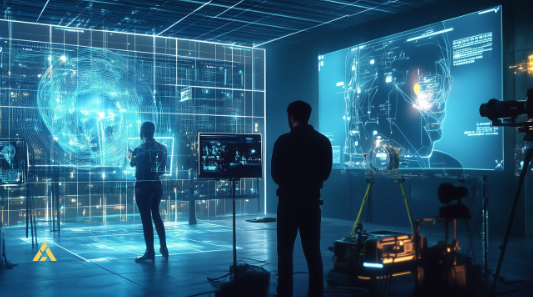
Runway’s tools have already appeared in real productions. They were used on segments of The Late Show with Stephen Colbert, assisted editors on MotorTrend’s Top Gear America, and contributed to the Oscar-winning film Everything Everywhere All At Once.
Beyond deals with studios, Runway has built an ecosystem around AI filmmaking. Since 2022, it has hosted the AI Film Festival, and by 2025 the festival grew so prominent that IMAX partnered with Runway to screen the ten winning films across theaters in ten U.S. cities.
CEO Cristóbal Valenzuela described it as a showcase for artists, emphasizing that the company’s team has roots in the arts and empathy for creators. The IMAX screenings sparked debate, with some cinephiles dismissing the films as shallow, but Runway and IMAX defended the event as an exploration of how technology and storytelling converge.
Runway’s approach has been clear: strike licensing deals, work alongside creatives, and provide augmentation rather than replacement. This has earned it goodwill in Hollywood. However, the company still faces legal scrutiny. Runway, alongside Stability AI and Midjourney, has been named in a class-action lawsuit by visual artists alleging their work was used without permission. Runway says it is pursuing licensing partnerships and collaborating with artists to establish ethical training practices.
Midjourney and the Legal Backlash
Midjourney became popular among independent creators for its ability to produce imaginative art from text prompts. Its imagery has been widely used in concept art and storyboarding. Yet in 2024 a California judge ruled that copyright claims brought by artists against Midjourney, Stability AI, DeviantArt, and Runway were worthy of further legal exploration. The case alleges that billions of images, including copyrighted works, were used in training without consent.
The key distinction is whether the final work reflects recognizable human expression rather than an automated process.
This lawsuit, still ongoing in 2025, represents one of the first major tests of whether AI training on scraped creative content is fair use or infringement. Several claims were dismissed, but the core copyright and trademark issues remain live.
Midjourney continues to innovate, and its latest models can generate near-photorealistic or highly stylized artwork. However, without licensing agreements or enterprise partnerships, studios see Midjourney as simply too risky. Its adoption remains largely grassroots, used by freelancers and designers rather than major studios. In the balance between creativity and legal uncertainty, most executives lean toward Runway’s more cautious path.
Adobe and OpenAI: Enterprise AI for Hollywood
Adobe entered generative AI with Firefly in 2023, emphasizing that it trained its models only on licensed and public-domain content. This “commercially safe” positioning has resonated with enterprise clients. Firefly’s early integrations into Photoshop and Illustrator yielded explosive adoption, surpassing one billion generated images in its first months and capturing millions of users.
By 2024 Adobe launched Firefly for Video, integrating generative tools into Premiere and After Effects. Features include extending clips, generating footage from text, and offering AI-driven camera angles for pre-visualization. While fidelity remains limited, Adobe’s trusted position in Hollywood workflows has made Firefly a leading choice for studios wary of legal risk.
OpenAI, by contrast, has been more controversial. GPT-5 is being used for brainstorming, script summaries, and marketing copy. However, the Writers Guild of America’s 2023 contract prohibits AI from writing or rewriting literary material and explicitly prevents AI output from being considered source material. Writers may choose to use AI tools, but only with consent and disclosure.
OpenAI also faces lawsuits from authors and creators alleging copyright infringement in training data. This uncertainty means GPT is used cautiously in Hollywood, primarily for productivity and administrative tasks, rather than core creative output.
AI in Production
Stage | Tools | Examples / Partnerships |
Development | Cinapse, ChatGPT | Cinapse (AI story-mapping & development partner for producers), Sudowrite (AI-assisted writing), OpenAI (script ideation for indie creators) |
Pre-Production | Runway Gen-3, Midjourney, Fable | Runway in music videos; agencies using Midjourney; Fable Labs testing AI |
Casting & Voice | ElevenLabs, Altered Studio, Synthesia | ElevenLabs dubbing/localization; Altered in games; Synthesia for training |
Production | ARWall, Cuebric, Runway Gen-3 | ARWall in backlots; Cuebric for AI greenscreen; Runway in ads/shorts |
Post-Production | Runway, Topaz Labs, Adobe Firefly | Runway in branded content; Topaz for restoration; Adobe Firefly in CC |
Marketing & Dist. | Opus, Jasper, iA Ad Network | Opus trailer clipping; Jasper for copy; iA influencer campaigns |
What’s Missing | Native AI for structured story/IP development | Existing tools stop at brainstorming/visuals — Cinapse fills this gap |
Voices, Likenesses, and New AI Frontiers
ElevenLabs has emerged as a leader in voice cloning, known for lifelike speech synthesis. In 2024, the company secured rights to recreate the voices of deceased Hollywood stars, including James Dean and Judy Garland, through estate agreements. Its Reader app allows licensed voice performances in audiobooks and film projects, setting a benchmark for ethical AI voice use.
What matters is the human shaping of the result, not the instruction that initiates it.
This approach contrasts sharply with unauthorized AI clones, such as viral tracks imitating Drake or AI-generated George Carlin routines, which prompted lawsuits and public backlash. New SAG-AFTRA contracts and California laws now require performer consent and compensation for any AI-generated voice or likeness, making ElevenLabs’ partnership-driven model attractive for Hollywood adoption.
Synthesia has similarly raised its profile by offering AI-generated avatars. In early 2025, the company raised $180 million at a $2.1 billion valuation, with more than 60,000 enterprise customers. While primarily used for corporate video, the technology is edging closer to entertainment applications such as background characters or localized dubbing.
Lessons from Music
The music industry’s early skirmishes with AI foreshadow the challenges now confronting Hollywood. In 2023, the viral track Heart on My Sleeve used AI to mimic Drake and The Weeknd without authorization. Universal Music Group quickly forced its removal, labeling it infringing and fraudulent. The incident sparked global debate and directly influenced new licensing initiatives, state-level “voice cloning” laws in Tennessee, and industry-wide calls for ethical AI adoption.
At the same time, the technology matured. Suno, an AI music startup, raised over $125 million by mid-2024 to accelerate its mission of democratizing song creation. Controversially, major artists like Timbaland publicly embraced the potential, debuting AI-assisted collaborations and arguing that the tools could become “the next sampler” — disruptive, but ultimately transformative if used legally and creatively.
These developments show the divide between unauthorized exploitation and transparent collaboration. Unauthorized mimicry invites lawsuits and regulatory crackdowns, while licensed partnerships and artist-driven experimentation build legitimacy. Hollywood has been paying close attention. Studios are already tightening contracts, demanding vendor transparency, and experimenting with watermarking to flag AI-generated material. The lesson is clear: only sustainable, legally sound pathways, built on licensing and collaboration, will survive the coming wave.
The Legal Landscape: Copyright in the Age of AI
Copyright remains one of the most unsettled areas in the AI era. U.S. courts have repeatedly affirmed that only works created by humans are eligible for copyright protection. In Thaler v. Perlmutter, for example, the court confirmed that AI-generated art cannot be copyrighted because authorship under the law requires human creativity. The U.S. Copyright Office recently reinforced this position, stating that fully AI-generated works fall outside copyright protection.
Licensed data sources and transparent AI partnerships will become increasingly important, both to secure copyright and to avoid infringement risks.
However, the door is not completely closed to creators using AI. Works that combine AI output with meaningful human authorship may still qualify. If a filmmaker, writer, or artist exercises creative control over the arrangement, editing, or modification of AI-generated material, those human contributions can be protected. The key distinction is whether the final work reflects recognizable human expression rather than an automated process.
Simply entering a text prompt into an AI system does not rise to the level of authorship. Courts and the Copyright Office have made clear that prompts alone do not provide the creative input necessary to secure protection. What matters is the human shaping of the result, not the instruction that initiates it.
What Can Be Copyrighted vs. What Cannot
Eligible for Copyright | Not Eligible for Copyright |
Works with substantial human authorship, such as a film, script, or artwork where AI was only a tool in the process. Example: U.S. Copyright Office (2023) affirmed that AI-assisted comic art in “Zarya of the Dawn” could be protected only for the portions created with human judgment. | Fully AI-generated works with no meaningful human input. Example: In Thaler v. Perlmutter (2023), the D.C. District Court ruled that works generated autonomously by AI cannot be copyrighted. |
AI-assisted works where the creator selects, edits, arranges, or modifies the output in ways that show creative judgment. Example: The Copyright Office has clarified that editing AI outputs with human creativity qualifies for protection. | Raw AI outputs generated solely from prompts without further human shaping. Example: The Copyright Office has repeatedly rejected registrations where the “author” was listed as AI rather than a human. |
Collaborations where AI is used like a traditional tool (similar to Photoshop or special effects software) but the vision and decisions remain human. Example: Courts have long upheld copyright for works created with technological assistance as long as the human is the author. | Machine-generated content where the system, not the human, is the “author.” Example: The Copyright Office explicitly rejected claims attempting to register AI as the sole author. |
Derivative works where human creators adapt AI material into a new creative context. Example: The Office notes that if a human substantially transforms AI output, the derivative work may qualify for protection. | Attempts to register AI itself as the “author” of a work. Example: Thaler v. Perlmutter confirmed AI cannot hold copyright under U.S. law. |
At the same time, lawsuits against AI companies test the legality of training models on copyrighted material without permission. The central issue is whether such use qualifies as fair use, a doctrine that permits limited unauthorized use of copyrighted works for purposes such as research, commentary, or transformation. The outcomes of these cases will shape the boundaries of AI training and define how future creators can legally engage with these tools.
For Hollywood, the implications are profound. Studios, writers, and artists must recognize that only their own creative choices are eligible for protection, while purely machine-generated output is not. Licensed data sources and transparent AI partnerships will become increasingly important, both to secure copyright and to avoid infringement risks. The industry’s trajectory will be determined not only by evolving technology but also by how courts and lawmakers resolve these fundamental questions.
What Can't AI Do?
Despite the advances in generative tools for text, imagery, and even music, AI has not yet cracked the hardest part of filmmaking: original story development. Studios, streamers, and independent producers alike are discovering that while AI can assist with formatting, outlines, or speed-reading libraries of scripts, it has not proven capable of generating market-ready concepts that are both original and structurally sound. The creative leap that takes an idea from spark to screen — weaving character arcs, emotional resonance, and thematic depth into a story that audiences care about — remains uniquely human.
This gap is exactly where Cinapse operates. Unlike off-the-shelf models that remix existing IP, inArtists, with a decade in Hollywood, built a proprietary story-mapping framework layered on top of advanced AI to generate, test, and refine truly original story worlds. Every project begins with an original idea and is developed in collaboration with our human-led team, augmented by AI, not in opposition to it. The result is a workflow that maintains the creative spark while dramatically accelerating the early development cycle.
For studios, producers, and award-winning creatives, this means a path to faster greenlights, sharper pitches, and richer IP pipelines without sacrificing originality or authorship. In a market where everyone is recycling franchises and sequels, originality is the most valuable currency.
Workforce Shakeups
The first and sharpest impact of AI in Hollywood has been in SFX/VFX. The sector has long relied on large overseas teams to handle time-intensive tasks like rotoscoping, keying, and compositing. According to the Visual Effects Society, more than 60% of VFX labor costs on major films have historically gone to this type of repetitive work. Now, tools like Runway Gen-3 and Cuebric can generate environments or erase backgrounds in seconds, cutting entire steps from the pipeline. A 2024 Deloitte study estimated that AI automation could reduce up to 25–30% of VFX labor demand within five years, threatening thousands of junior and mid-level jobs worldwide.
Animation faces a similar disruption. Studios that once employed hundreds of storyboard and clean-up artists now experiment with generative pipelines: character designs in Midjourney, motion interpolation with Ebsynth, and AI-assisted lip-sync via ElevenLabs. Pixar’s former CTO, Ed Catmull, has publicly acknowledged that AI will "compress production timelines dramatically," and forecasts suggest AI could cut animation pre-production costs by 20–40% over the next decade.
But the picture isn’t purely one of loss. As rote tasks disappear, demand is growing for AI-native roles: technical directors who train models on studio IP, animators who "direct" AI systems rather than draw every frame, and hybrid artists who can blend traditional craft with machine efficiency. The SFX or animation artist of tomorrow won’t be replaced—they’ll be redefined as the orchestrators of entire AI-driven worlds.
The Road Ahead
The tools most likely to succeed in Hollywood will not only be powerful but also transparent and legally sound. Runway exemplifies this model through its Lionsgate partnership and artist-centered ethos. Adobe provides safe integration for existing pipelines. OpenAI, ElevenLabs, and Synthesia add value in writing, voice, and avatars, but face constraints and scrutiny.

AI is replacing many creative roles, particularly in technical and repetitive tasks, while simultaneously becoming a powerful set of tools that can accelerate workflows, lower costs, and expand possibilities. The winners in this space will be those who adapt quickly, combining innovation with respect for rights, and redefining collaboration across the industry.
Hollywood’s deal with AI, in the end, may resemble the Lionsgate-Runway partnership: an open-ended collaboration where storytellers and technologists bring their strengths together. The industry is not giving the keys to machines, but it is inviting AI to play a supporting role. The credits are still rolling on this story, but one thing is clear: Hollywood and AI are rewriting the future of entertainment, together.
Insightful perspectives and deep dives into the technologies, ideas, and strategies shaping our world. This piece reflects the collective expertise and editorial voice of The Weekend Read.


Comments